


Welcome to the SPFBO Champions’ League! As you know, this is a special edition where we try to find out who will be the ultimate Champion among the last 10 SPFBO winners. Check out our SPFBO Chamopions’ League page for more info! SPFBO Champions’ League ends on December 20th, and we’ll post our reviews every 3 weeks or so.
Our 6th SPFBO Champion review is for The Sword of Kaigen by M.L. Wang, the winner of SPFBO 5. The reviews within a post will be in alphabetical order.
A quick reminder about how we are proceeding in this edition: our judges had the freedom to opt out of reading any of the books due to personal interest, time restrictions, unforeseen life events, etc. Our aim is to have at least 4 reviews/scores for each Champion.
Once again, we’ll have a DNF rule in place: if a judge reads a book (if they didn’t opt out beforehand), they have to read at least 25% of it, although encouraged to read at least 50% since we are talking about champions. At whichever point they DNF, they’ll have to write a review and put a score in our spreadsheet.
As per the new rules for the SPFBO Champions’ Editidon, there aren’t going to be any public scores, but we’ll have them to help us decide the ranking. However, they won’t be shared anywhere. We will also have a mixed set of old and new reviews, meaning that if any of us reviewed a book before, we can reuse that review. Therefore, we’ll mark our reviews at the beginning as old or new.
For The Sword of Kaigen, we have 6 reviews for your reading pleasure.
So, without further ado, let’s take a closer look at our 6th Champion!
Table of Contents

| Series: | standalone |
| Genre: | Fantasy |
| Publisher: | self-published |
| Date of Publishing: | February 19, 2019 |

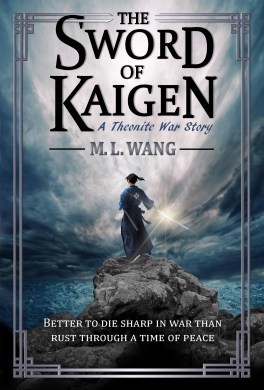
A mother struggling to repress her violent past,
A son struggling to grasp his violent future,
A father blind to the danger that threatens them all.
When the winds of war reach their peninsula, will the Matsuda family have the strength to defend their empire? Or will they tear each other apart before the true enemies even reach their shores?
High on a mountainside at the edge of the Kaigenese Empire live the most powerful warriors in the world, superhumans capable of raising the sea and wielding blades of ice. For hundreds of years, the fighters of the Kusanagi Peninsula have held the Empire’s enemies at bay, earning their frozen spit of land the name ‘The Sword of Kaigen.’
Born into Kusanagi’s legendary Matsuda family, fourteen-year-old Mamoru has always known his purpose: to master his family’s fighting techniques and defend his homeland. But when an outsider arrives and pulls back the curtain on Kaigen’s alleged age of peace, Mamoru realizes that he might not have much time to become the fighter he was bred to be. Worse, the empire he was bred to defend may stand on a foundation of lies.
Misaki told herself that she left the passions of her youth behind when she married into the Matsuda house. Determined to be a good housewife and mother, she hid away her sword, along with everything from her days as a fighter in a faraway country. But with her growing son asking questions about the outside world, the threat of an impending invasion looming across the sea, and her frigid husband grating on her nerves, Misaki finds the fighter in her clawing its way back to the surface.

Arina
Read: 100%
Review: New
Ask ten reviewers what their favorite self-published book is, and eight of them will name The Sword of Kaigen without hesitation. But popularity doesn’t reassure the high expectations of new readers. Fortunately, The Sword of Kaigen not only stands tall in the face of the challenge—it soars.
The Sword of Kaigen refers to both the Kaigen Peninsula’s elite warriors—their legacy, legendary elemental magic, and historic role in past wars—and the mountainous land they inhabit, reinforcing one of the novel’s most powerful themes: the connection between person and place.
Deeply traditional and helmed by the legendary Matsuda family, Takayubi village is host to near-mythological warriors, who pride themselves in their roots and train those younger to rise equal or beyond them. Among the students is Matsuda Mamoru, the oldest heir of the Matsuda legacy. His journey intertwines with his mother’s, Matsuda Misaki, and dives deep into personal belief, leading readers to reflect on their own values.
Together, their intertwined arcs enrich the Japanese-inspired worldbuilding, which draws from their perspectives and experiences, offering a generational reflection on identity, loss, and the value of tradition.
Stories of such resurgence often hinge personal growth on rejecting the old for the new (and often that new is a western or western-like culture/belief system and the old is not), but M.L. Wang writes a premise far more nuanced, where strength comes not from the total abandonment of tradition, but from its reclamation.
Misaki’s arc could have easily fallen into a familiar trope: the achievement of feminist liberation through rejection of culture—trading her roots for a new identity aligned with westernized or industrialized ideals of progress and modernity. Instead, she claims her space within it, proving herself a mother, a swordswoman, and a leader—not by erasing her past, but by reshaping her future on her own terms.
Mamoru’s journey runs parallel to his mother’s. He doesn’t become stronger by simply uncovering the government’s lies and refusing all its adjacent responsibilities and upbringing. He grows by reevaluating his own motivations, understanding the weight of his actions, and deciding what truly deserves defending.
Both he and Misaki are forced to confront painful truths, regrets, and disillusionment—yet their strength is drawn not from institutions, but from the people they love and the values they choose to uphold.
Thus, the novel challenges the idea that progress requires cultural erasure, choosing to embrace how tradition, when held with integrity and introspection, can be a source of immense personal and communal power.
The Sword of Kaigen isn’t just about cool ice dragons, elemental battles (which admittedly, can get quite long) and political secrets, even though it deftly depicts all those. It’s mostly a deeply personal story about carving one’s place in the world and forging a path forwards—even as you struggle with your past. And for that, even with all its many narrative flaws and abandoned plot-points (of which are too many for a book claiming to be a standalone), I truly loved it.
(It’s also definitely about cool ice dragons).

Drew
Read: 100%
Review: new
SPFBO 5 was the first year I was a judge, and The Sword of Kaigen was the book I rated highest out of the finalists I read. Not having read it in the interim, I was curious to see if I would still enjoy it as much five years later.
As it turns out, the answer is “Yes, but…”
Set in an asian-influenced second-world which combines very traditional settings, attitudes and relationships, alongside a level of technology comparable with our own.
The mixture of old and new could catch an unsuspecting reader off guard although, since the narrative mostly takes place within the environs of Mt. Takayubi, one of the more rural and isolated parts of the Kaigenese Empire, the tech can mostly be ignored except when needed as a plot device.
I still really enjoyed the elements that had appealed to me originally; the combat scenes, the magic system and the interplay between the two. The characterization, particularly of the two main protagonists, is still exemplary and it retains the heavy emotional punch I remembered. And while I appreciated a lot of the world building and the attention to detail, I do stand by my original opinion that the number of various honorifics can be confusing, even with the glossary.
What I did struggle with more was the level of sexism leveled against the female characters, and at Misaki in particular. It becomes particularly galling once the flashback chapters begin, and we learn how capable she is and how decisive she used to be before agreeing to the marriage her parents arranged for her. Having said that, and also recognising the groundwork those flashbacks lay for Misaki’s backstory and eventual catharsis, a lot of them feel more superfluous this time around. In fact, some feel more like set up for a potential sequel or spin-off. The same could also be said for some events that take place in the final chapters, leaving me with the impression that they weren’t really necessary and actually detract from the tightness of the story.
All of this might sound like I’m being harsh but I loved this book the first time I read it and I loved it during this re-read. It’s because so much of it is so good, the flaws seem to be more apparent now. But, for all that, I would still wholeheartedly recommend this book and would still rate it very highly.
Filip
Read: 100
Review: Old but edited
I was left speechless and humbled by The Sword of Kaigen, a beautiful, heroic tale of duty, love, and loss, when I first read it in 2019–and for good reason.
I always have difficulty speaking about the fantasy books that win me over as completely as The Sword of Kaigen has. When I come across an excellent novel, my first instinct is to fall silent. But let’s give it a try, shall we?
Takayubi is a small village within the Kaigenese Empire, unremarkable in most ways except in one – it is home to the mightiest jijakalu theonites, water-wielders, that the Empire has ever known, the Matsudas. These powerful warriors spend their lives training for a conflict that won’t come with a rival country whose last strike on the Sword of Kaigen, as the Takayubi warriors call themselves, ended in utter defeat. Or so the history books say.
The ultimate foundation of this novel is doubtlessly the character work. I did not expect to discover characterization which equals that of Robin Hobb, but it does; character action (and inaction) is the driving force behind much of what happens in M. L. Wang’s 2019 SPFBO winner. At the centre of the interconnected web of characters around which this novel revolves, lies Misaki, the wife of Takeru, the younger of two Matsuda brothers. Misaki, a mother of four, at first appears a docile, even meek, housewife, accepting of her role to ‘push out Matsuda babies’ who are to be trained as great warriors, more vessels of divine power than human beings with a will of their own. But what at first appears as complacency in Misaki is in fact the result of a constant conflict between the strength of her personality and the expectations of the traditional, conservative society she is part of.
And what a traditional society it is! The Kaigenese empire, alone among virtually all its peers does not permit women to take part in its military or its political life; outside their family, Kaigenese women are voiceless. Some, Misaki among them, have no voice even within their families. There’s a real disconnect between all the scientific advances the Kaigenese Empire has at its fingertips and the pre-Industrial way of life of its warrior caste. This forces home a point about the nature of this empire and its relationship to its subjects; I won’t spoil it here but it is nonetheless a poignant commentary on duty, loyalty and obedience.
Playing into this is Mamoru, Misaki’s firstborn son, who is as fascinating as his mother – having grown in a world of ice-cold certainties, he nearly crumbles when faced with proof that everything he’s believed in is based on half-truths and deceptions. Only fourteen years old, Mamoru goes through a harrowing experience that most grown men wouldn’t be able to deal with anywhere near as well as he — such a substantial shift in worldview makes or breaks a person. Following the changes that overcome him as he adapts to a world more complex than he thought possible is a treat, his pain understandable and his growth rewarding.
Takeru, Mamoru’s father and Misaki’s husband, is a cypher – cold and distant, a tyrant to his family, nevertheless there’s more going on in his internal world than he lets on. M. L. Wang offers up the pieces of the puzzle one by one, from the first time Takeru is mentioned all the way until everything falls into place – and although, or perhaps because, there are plenty of flaws in the younger Matsuda brother, he is fascinating.
The relationship between Takeru and Misaki is the key to this novel and to the prisons each of these characters have made for themselves.
Action is difficult to write well, but more difficult to write in such a way that every exchange of blows, be they sword strikes or the back and forth of magical assaults, elicits an emotional response not only from the characters but the reader as well. Nothing is off the table with Wang, and no character is safe. The display of intricate ice and water-based abilities by the Matsuda brothers show a brilliantly imaginative side to M. L. Wang’s writing. This novel is heartachingly beautiful, a story of lost potential, betrayal and perseverance in the face of unimaginable loss, so beautifully human that it will leave you speechless.
Rari
Read: 100%
Review: old
This has been on my TBR for a while, and after reading Blood Over Bright Haven, I had to know how this compares.
The story revolves around Misaki, who has married into the Matsuda family in an arranged marriage. She had to give up her independent nature and her love of fighting in order to be the traditional housewife she is expected to be. The land of Takayubi where the Matsudas live still holds to its traditional values and blind faith in the emperor who rules them. Misaki’s son, Mamoru is the other focus of the book. He has always known his purpose, but the arrival of a new student in school has him doubt everything he knew about his land and its people. When an unexpected invasion by Kaigen’s traditional enemies, the Ranganese, who were once part of the empire but who rebelled and managed to divide the empire, suddenly happens, Misaki and Mamoru as well as the rest of Takayubi finds that they need to forget their doubts and docility if they’re to survive.
The story is in part a commentary on a woman’s lot in a traditional society. As someone coming from a culture where arranged marriages are common, where the expectations on women are to be good housewives and mothers, I found Misaki to be a relatable character. She had to give up everything that made her who she was in order to be a good wife to Takeru and mother to his children. She resents it but has learnt to hold her tongue, to say yes and amen when she wants to lash out.
Mamoru is heir to the Matsuda technique of Whispering Blade, a method by which a warrior can create a blade of ice so strong and sharp that it can cut through steel. Since the first it has been created, every Matsuda has attempted to emulate it, though not all have succeeded. Mamoru’s father and uncle could both create Whispering Blades, but his grandfather couldn’t, and Mamoru himself has been unable, at fourteen, to do it. He is full of insecurities despite being the strongest Matsuda ever.
Takeru is as important as the other two, and starts out as an unlovable character. He is cold towards his wife and children, diminishes and puts down Misaki and silences her at every turn. He’s angry when Mamoru questions the empire’s propaganda, and even during the invasion and its aftermath, behaves coldly and disappears when his people needed him the most. We do get an explanation for his behaviour, but to me, that’s not entirely convincing. Still, Takeru does show growth during the course of the book, and he and Misaki learn to communicate as well.
This book also touches upon the apathy and indifference of a society as a whole which is further expounded in Blood over Bright Haven. However, in this, the Takayubi people realise they have been blind and changes, unlike the Tirannese in Blood over Bright Haven.
The magic system is well defined and the world building is done very well. This is a story of human struggle and endurance and of relationships and family. I loved the characterisation, even though, as in Blood Over Bright Haven, some of the characters are more or less caricatures. There are deaths that ripped my heart out which even now chokes me with grief when I think of it, but the ending is on a positive and hopeful note just as in Bright Haven.
I did cry a lot, like full on ugly cry while I was reading. I love books that make me feel so much. I am still reeling from everything that happened on its pages.
While I respect the author’s decision not to continue the series, I am also saddened by it. It’s a world and people well worth visiting and the themes are very relatable and universal.
Highly recommended to anyone who enjoys fantasy, and specifically to those who enjoy eastern fantasy, high fantasy, epic fantasy and well defined magic systems, world building with excellent characters.
Timy
Read: 100%
Review: old
I’m going to start with ripping the bandage off: I did not like The Sword of Kaigen. At this point you’ve probably read many glowing reviews of it and heard many people singing praises about how fantastic it is. And surely that many people can’t be wrong, but once again I find myself in the minority. I guess that’s just my role in life – quite literally, as I happen to be short. Ironic, isn’t it? But let’s talk about the book at hand, shall we?
The Sword of Kaigen is set in a world inspired by feudal Japan if it had modern technology which is a bit weird at first, but then I remember that modern day Japan (or many other countries for that matter) do have these small villages that are still clinging to the old ways and are not really keen on modern technology – either because they can’t afford it, or because they are fine with things as they are. Traditions are stronger than anything else. Seriously, look at Japan.
I had really mixed feelings throughout reading the book. Personally, I liked Mamoru the most. Yes, he was a brat, but come on, he is 14 years old, his view of the world was challenged by this new kid who comes to the village with much more knowledge about the world. Give the guy a break. Taking everything into consideration, he coped pretty well. But he is not the main character of this story. Sadly. Instead, we have his mother, Misaki. I honestly still have no idea how I feel about her, and it’s been a few months since I read The Sword of Kaigen. There were moments I liked her, even sympathized with her, but eventually she annoyed me more than not. Though I appreciated her character arc as she finally stood up to herself and made an effort to bridge the gap between herself and her husband. My favourite moments regarding her were the scenes with Mamoru, which showed how deep the bond between them is and how much she struggles with the rigid rules of her role. Learning about her past was interesting, to a point. I think it was mostly an unnecessary filler as it really didn’t add much to the story, or her character, except that we learn she was an adequate fighter. Good for her.
As for the writing, Wang definitely has a knack for it, as there were some really powerful emotional moments. But I also think this book needs at least one more editorial pass. There were scenes where I was supposed to feel any number of emotions, and the tension was ther,e but they were just stretched out for way too long to a point where I thought “okay, I get it, I’m feeling whatever you want me to feel, but can we please just move along?”. I’ve been going through phases where I was sitting on the edge of my seat, and phases where I was bored out of my mind and slugging through had become a chore.
Having the climax in the middle of the book sure was a choice. I probably would have enjoyed The Sword of Kaigen more if it started after the middle and focused on the aftermath and how it affected people and the village, rather than the long buildup at the start, with a lot of infodump. I would also have appreciated more worldbuilding to understand the politics and how the government worked behind the scenes.
All being said and done, I left the story behind with a feeling of being underwhelmed. The Sword of Kaigen had a lot of promise, but failed to deliver. Ultimately, I couldn’t really connect with any of the characters, or the story for that matter. I think I can see why others love this book, but if it weren’t for SPFBO, I would have DNF-ed it way before I got to the end.
Tru
Read: 100%
Review: new
I’d been excited to read The Sword of Kaigen ever since I became obsessed with the author’s other fantasy standalone, Blood Over Bright Haven. The Sword of Kaigen is perhaps one of the biggest, well known, and most successful self-published fantasy books out there with almost eighty thousand ratings on Goodreads. That’s more than some traditionally published books! Needless to say, the hype is there, and I was so eager to dive in and experience it for myself.
So what did I think of this indie masterpiece?
The Sword of Kaigen is set in a Japanese-inspired world with various nations, some of which have Avatar-inspired elemental magical abilities. Part of this world seems to be contemporary, with modern technology, whereas the island where most of the story is told is more traditional and they live based on the traditions of sword training and fighting. The story, then, is told from two POV’s within the famed Matsuda warrior family – Mamoru, the fourteen-year-old son and warrior in training, and Misaki, his mother. Both offer differing views of life within the world, as Mamoru begins to question the propaganda of the empire, and Misaki juggles her place as wife and mother having come from a world beyond the propaganda.
As the story moves on, we see hints of potential war in the background, and the first half of the book builds up to an amazing conflict which thrusts Mamoru and Misaki into the heart of battle and truly gives them an opportunity to unleash their skills, physical and magical. The writing and tension here is incredible, and at this point in the story I could truly understand how this book lived up to the hype.
Sadly, it’s the second half of the book which left me a little disappointed. After the climax in the middle, the characters take time to recover, which has some truly poignant scenes. I expected them to react differently, to make a plan of action, but it felt like the story fizzled out. The Sword of Kaigen is a standalone, but in the second half of the book new story elements are introduced and left unresolved that gave the impression this was meant to be a series. The inclusion of these left me a bit baffled, and I think the story would have been much stronger without them.
The story also suffers from a slow start and info-dumping which could have been cut or handled better. There’s an entire chapter later in the book which is just about the world’s gods and it doesn’t add anything to the character development or story.
Ultimately, I believe that the author’s storytelling and writing are incredible, and M.L. Wang certainly knows how to throw emotional punches without holding back, therefore I feel The Sword of Kaigen is an experience worth reading. However, some further editing and cutting would have made this a much more cohesive and stronger book.
For more SPFBO content, please visit our SPFBO Champions’ League page!
If you don’t want to miss any of our posts, please consider signing up to our monthly newsletter or follow us on social media:


Leave a Comment