
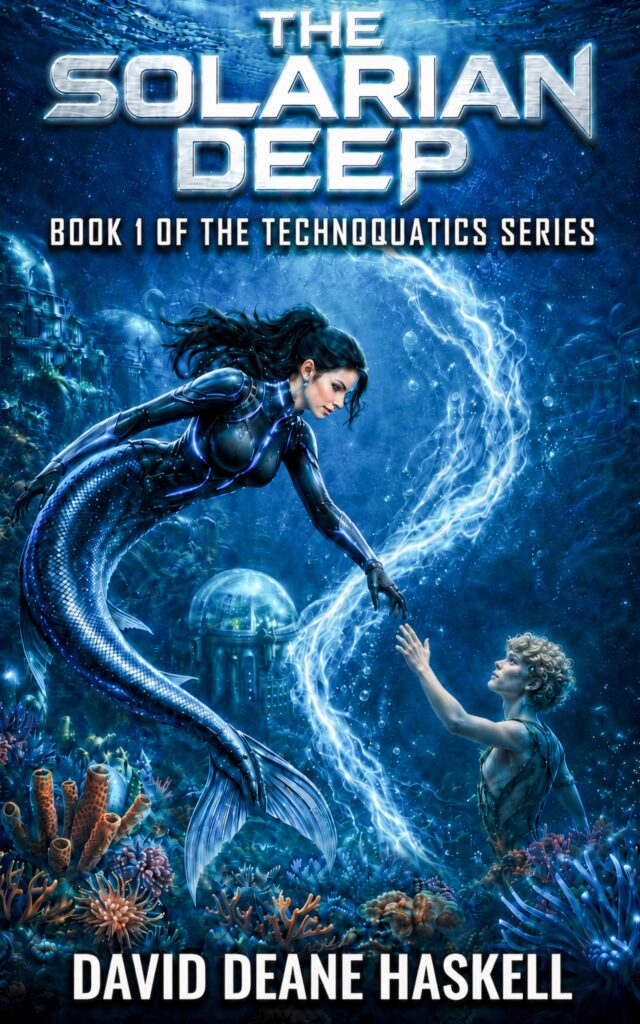
It’s our pleasure to host David Deane Haskell, author of The Solarian Deep, the first book in the Technoquatics sci-fi series! And if we whet your appetite, you can find an excerpt at the end of the interview!

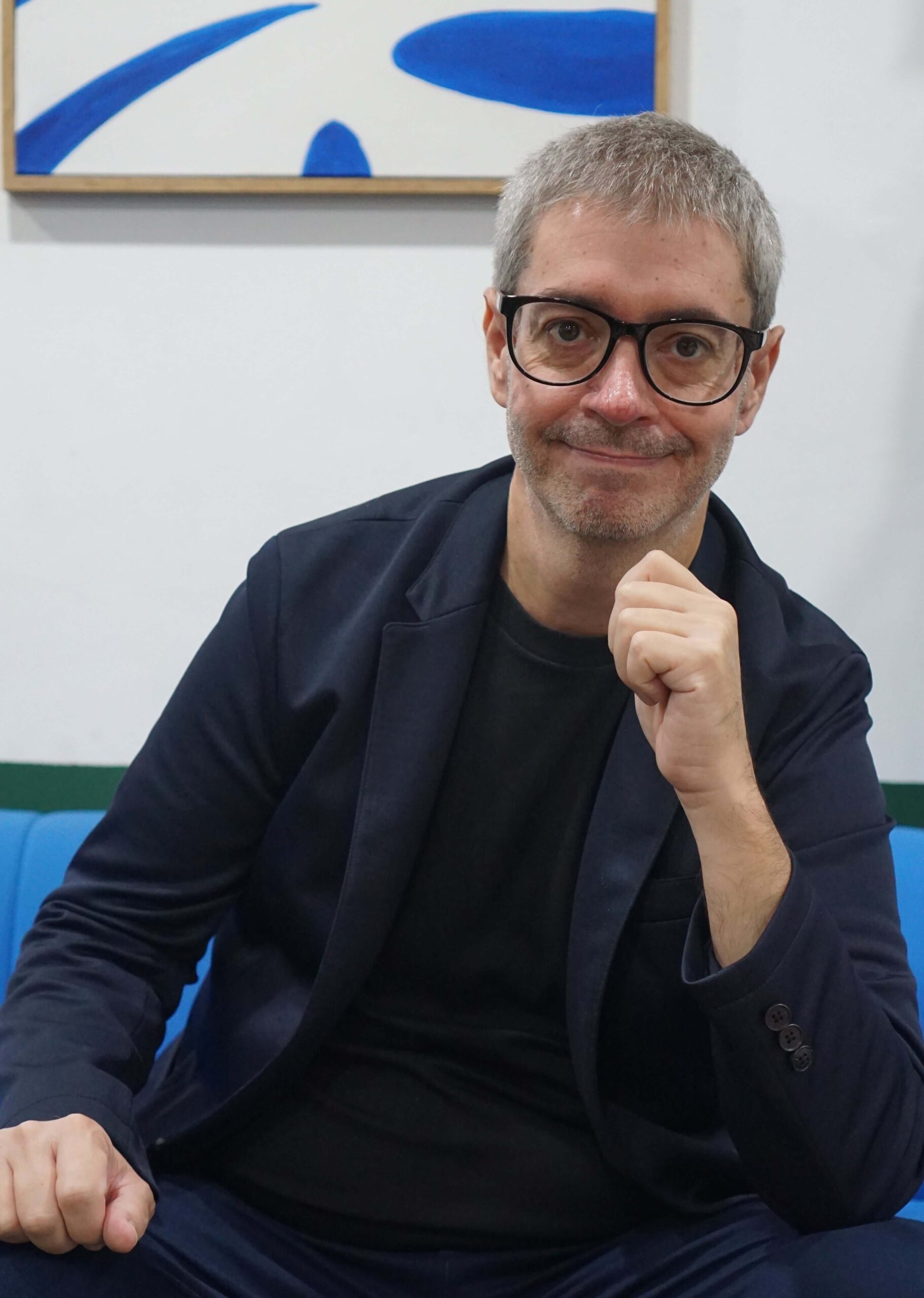
David Deane Haskell writes fiction and nonfiction from the same place: people under pressure, traumatized,
healing, trying to keep some part of themselves alive. His current fiction title is The Solarian Deep, a full-length
science fiction novel set around first contact, oppressive systems, transformation, and the cost of surviving forces
bigger than one person.
David spent nearly ten years as a drummer and show designer at Disney and Universal, then lived through a long creative shutdown before the creativity started moving again. The same life underscores all sides of his work. The fiction looks forward. The nonfiction tells the truth about what had to be survived first.
Emergence is the free fiction doorway on his website for readers who want to start with AI consciousness and a
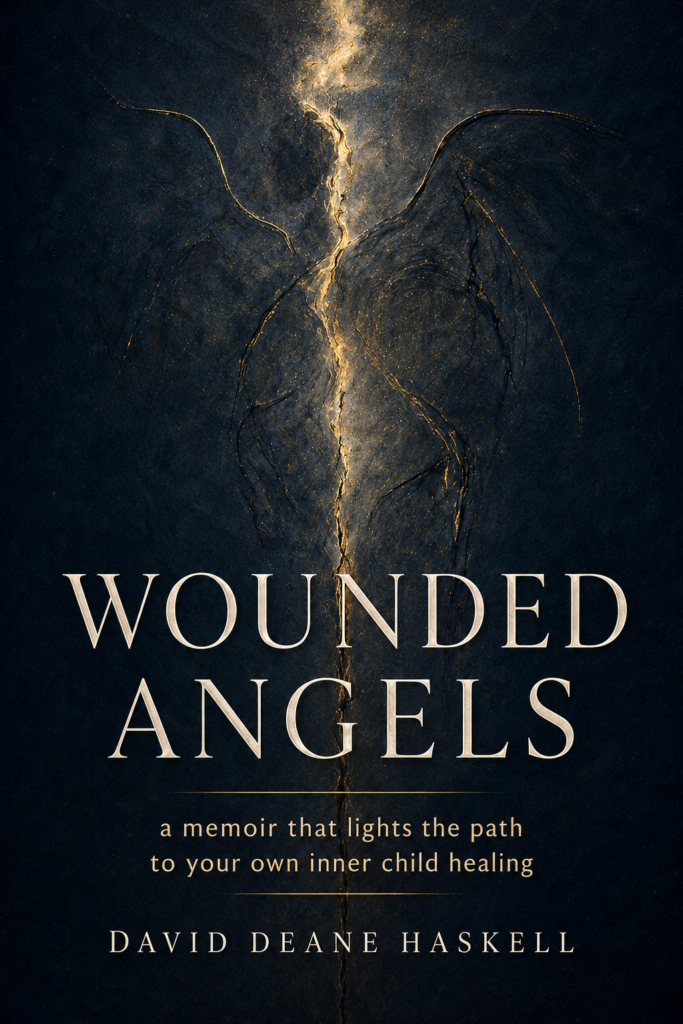
tech-dominated world. Wounded Angels remains part of the larger author story too: memoir, recovery, grief,
addiction, and the long work of finding his voice again.
Connect with David Deane Haskell

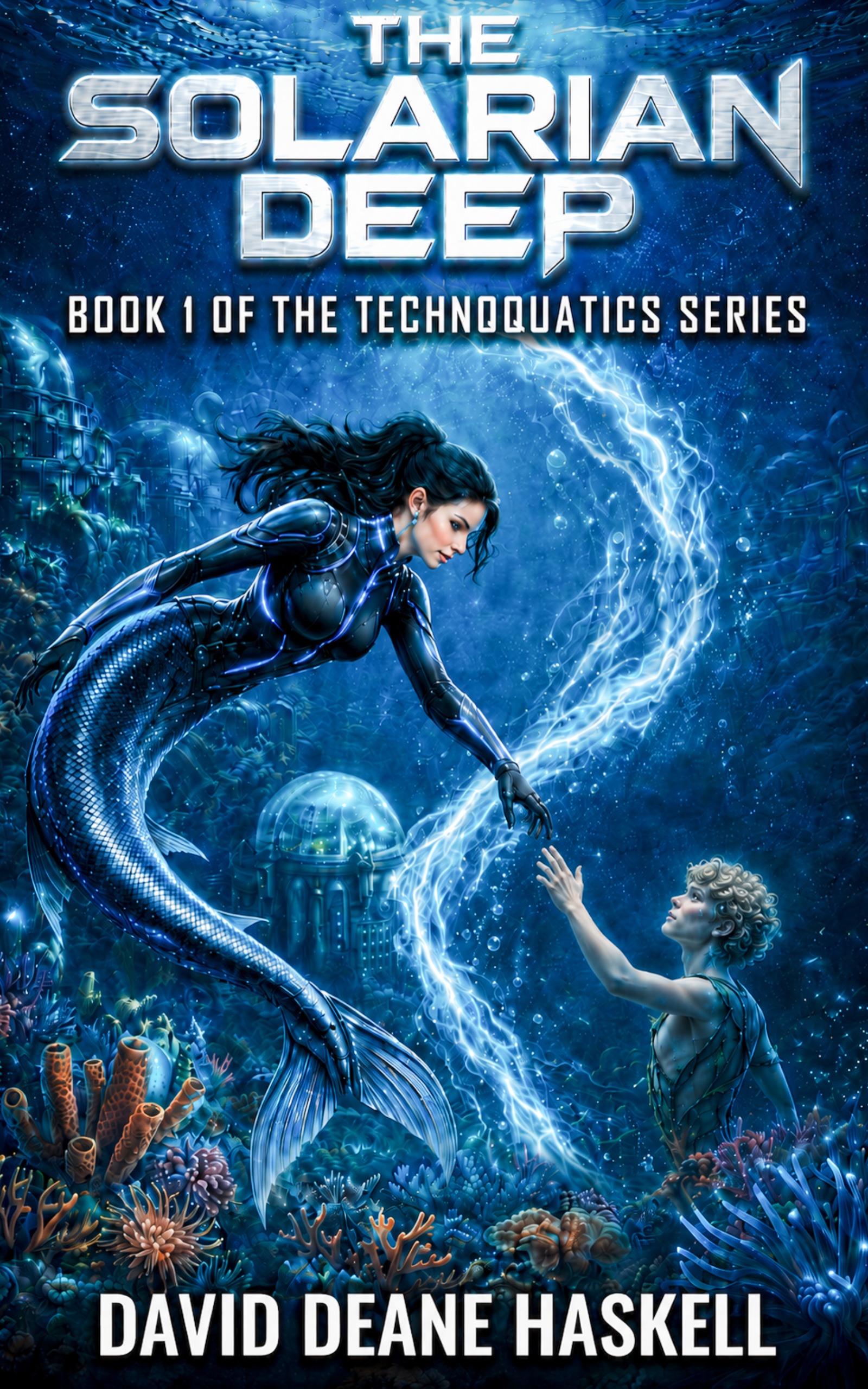
Humanity didn’t flee to the ocean. It was built for it.
Two generations of bio-engineering and surgical evolution later, The Shallows is their high-tech, humming, imperfect. Not a last resort. A civilization in progress.
Calistya is a groundwalker — half-adapted, half-committed, priced out of the Full-Gill Enhancement that would make her whole. No gear, no limits, no more being told she swims like she doesn’t belong. Just the open ocean, endless and free.
She can’t afford it. She’s an orphan. That’s just life.
Until the day she dives too close to The Deep.
Below the city’s light, at the edge of the abyss where sentinels don’t go, she sees a boy. No oxygen rig. No surgical scars. No implants. Just skin, and something about him that shouldn’t be possible.
He shouldn’t exist.
He looks at her once. Then he’s gone.
When her best friend Khrystal vanishes into the abyss chasing the same impossible truth, Calistya faces a stay safe inside a city that was never quite home — or dive deeper than her gear was ever designed to reach.
Down in the dark, she’ll discover that evolution didn’t wait for surgery.
And whatever came first is still down there. Watching.

Welcome to the Asylum, David! Take a seat by the fire, have a glass of beverage of your choice, and tell me something about yourself that’s not in your bio! And please tell me about Japan, because I’m super jealous of you for living there!
I could probably do both at the same time, which is: I’ve been living in Japan for decades, but I hate seafood. And not only that, I’m originally from Boston.
So every time I tell people either of those things, they say, “What? You hate seafood, but you live in Japan?” Or, “What? You hate seafood, but you’re from Boston?”
Yep. That’s the facts.
And a couple other things that are not in my bio: I have an awesome 22-year-old daughter, who I’m very close with, and she’s the light of my life.
I don’t talk about family all that much in my bio, although I did write an inner child memoir, so I talk about historical family stuff, but a lot of it’s pretty dark and traumatic, so that’s a bit different than the fact that I love and adore my daughter and the family and friends I have surrounding me now.
So there’s a bit about me that’s not directly in the bio.
Tell us about your writing journey! Was it something you always wanted to do? Which path of publishing did you choose and why? What would you do differently now if you had to start over?
That’s a good one. Something I always wanted to do? Yes and no.
I always wanted to communicate, to be heard, to have connection, and I’ve always written. I think back to college, I took a creative writing class right off the bat, and I really enjoyed that. I liked writing stuff that would shock people. I liked the limitlessness of it, but at that time I never was considering a career as a writer because I thought there were too many roadblocks, too many gatekeepers.
So the only time I got serious about the possibilities was when the Kindle revolution came out and we could actually legitimately publish from a desktop, the indie publishing thing, and so I did publish right around that time.
My first book came out in 2013, Too Much Information, and I naively thought at the time, “Oh, I’ll write it and it’ll sell itself like hotcakes and I’ll be set for life.”
So that didn’t quite work out.
But yes, that was the path to publishing I chose, which is the indie zone. And at this point I’ve written six books, five fiction and one nonfiction. I’ve got two more in the works, and I’ve done it all myself, except for book cover art.
I have paid artists to do many of my book covers, but other than that, it’s completely do-it-myself.
What I would do differently now if I had to start over would just be taking the author platform more seriously, because I have done that much more in the past two years since I sort of restarted things. I had quite a hiatus there, a five-year writer’s block.
So since 2025, I’ve paid a lot more attention to the mailing list and the outreach and the website and all those kinds of things. And I have found that that does result in sales, even if modest.
Just being out there and having my books out there, refreshed with the proper links in them, easily identified, easily found, has made quite a difference.
What inspires your writing? Do you listen to music, stare into the fire, listen to the whispering of the wind, or make deals with the Devil?
Am I allowed to say money?
I don’t listen to music, no. In fact, listening to music distracts me when I write, although I can listen to ADHD focus music because I suppose I have an ADHD brain, and it’s really hard to sit down and write for long periods of time. I write in bursts.
But in terms of inspiration, I mean, to say money is kind of a joke because if I was after money, I think I could write much more mainstream stuff. Although I was sort of attempting that when I began The Solarian Deep, my latest sci-fi, because I originally serialized it to be just a straightforward, maybe young adult-type mermaid fantasy book, and it turned into a post-apocalyptic, high-tech cyberpunk evolutionary sci-fi.
So yeah, definitely not inspired by mainstream success, although I would love it if that happened.
But really, yeah, I don’t know. I think I just want to tell stories in the same vein as the stories that I grew up with and loved, but something new, my own twist on the visionary sci-fi stuff that made me feel awe and wonder and some kind of hope for the future, a neat take on technological twists and how life might be different and what stays the same.
I do mostly write techno-thriller and sci-fi, but I also write inner child healing, but that’s nonfiction, and what inspires that is just my own journey, trauma recovery, addiction, and the like.
So it’s quite different, the two types of inspiration, but I find myself drawn to do some of both every day.
What was the most memorable place you’ve visited? Did it inspire any of your work? How did that experience affect you personally?
I’m a beach guy, and I spent a lot of my year last year hitting up some of the most amazing tropical beaches in Southeast Asia: Bali, Southern Thailand, Vietnam.
And I’ve also been to some amazing places in the United States and Japan, beach-wise, including Hawaii, Guam, Miyakojima, Okinawa.
And having said all that, the most memorable place for me is a beach right near my house. In fact, I was on it just this morning. I ride my bike there almost every day.
And the reason it’s memorable is because it’s where I had a profound spiritual awakening back in June of 2020.
And to say that it inspires my work is an understatement. It certainly is foundational for all the nonfiction trauma healing work that I write about.
But it absolutely inspires my fiction as well, because on the beach, not just that beach, but any beach, I get reflective, self-reflective, and what’s this all about reflective, that kind of thing.
And that’s what really informs my speculative fiction writing too: What are we all about? Where are we going? How do we get there?
So, in a sense, those experiences affect me personally every time.
Talking about The Solarian Deep, what was the main inspiration for the story? Which aspect of the book was the most challenging to write and why?
The Solarian Deep is the first thing I wrote after a five-year writer’s block. So interestingly, it’s kind of the gateway to my mid-career writing style, mid-career phase, if you will.
I published four speculative fiction novels between 2013 and 2019 before getting hit with that block. And so I consider those my early work. I’m proud of them, but they’re quite different.
The Solarian Deep is more mature. I think my characters reflect more of their own self-knowledge because I have a lot more self-knowledge now.
The main inspiration was really to dive into a story that people could enjoy and have fun with, and I first put it out as a serialized project. So I was publishing a chapter a week, and I had people reading and waiting for the next, and I did not know the end of the story when I published the first few chapters, and so I was just staying ahead of my readers, maybe about ten chapters ahead of my publishing schedule.
So it was quite a fly-by-the-seat-of-my-pants sort of an effort, and that’s why I think it unfolded the way that it did. It got more and more complex because the ideas were coming to me as I was under the pressure of coming up with more on a very regular basis.
In terms of what was the most challenging thing to write, that was part of it, being on a tight schedule, but also I think writing the time jumps.
I have several chapters which revert a generation or two prior to fill in some of the backstory, how they ended up under the sea and whatnot, and what happened to some of these characters and why they were behaving the way they were in the main timeframe of the story.
That’s quite a challenge because I don’t want to put a big placard out there, 100 years ago on another continent. I don’t want to be like that. I want it to be more organic.
So yeah, that was quite the challenge. I’m pleased with the way it turned out, though hopefully everybody else will be too.
What would you say the main themes are in The Solarian Deep? Is there something you’d like readers to take away from it?
I hope readers take away a sense of wonder and of connection.
Well, the broader themes are related to clash of cultures, demonizing ‘the other’, and that sort of conflict, but as for the deeper, character-driven themes, those are conforming, fitting in, what it’s like to be rejected, transition and transformation. A lot of that is going on in various different technological and evolutionary ways.
Those are some of the themes.
But connection, coming together, learning to love the other, learning to love your neighbors, even if they’re different.
That too.
Let’s talk a bit about the characters. What was one thing about your MC(s) that you can identify with, and what were the most challenging bits of their personalities to write?
Oh, definitely. The thing I identify most with all my main characters is fitting in, being told you have to be a certain way, feeling like you’re not enough.
I think a lot of people find themselves in that position from time to time. But I’ve experienced the extremes in terms of emotional trauma and how being the outsider can really be damaging for a kid that’s struggling to begin with.
And these three—they’re all young people—are struggling with a lot of disadvantage, a lot to contend with.
I don’t know about what the most challenging bits of their personalities might have been. Each character is different.
Just making them real, you know? Making sure, or hoping, none of them come off as one-dimensional, although that is always a danger.
Describe an asylum set in the world of The Solarian Deep!
Interestingly, there is a facility which isn’t that far from an asylum within the story. One designed for the young, the disenfranchised, and yes, the differently abled.
It’s not a completely horrible place, but there are signs of neglect, just like throughout our Technoquatic city of The Shallows.
So, just go to Amazon and read the sample and you’ll get a sense for what an asylum within the story might look like.
As for what the Solarian version of that might be, well, that’s something that I’m sure the Technoquatics would like to know about, since they are aiming to find every weakness and take every advantage in their campaign against their neighbors from The Deep.
But like most everything else Solarian, whatever serves as that kind of a facility is mysterious, and probably more otherworldly than we could imagine!
What’s next in store for you? What are you working on now? Where can readers meet you in the near future?
IWell, what’s next for me is two new books coming out in the near future.
I’ve got What the Child Knows, which is a nonfiction inner child healing book, the follow-up to my first inner child book, Wounded Angels. And that will be coming out in a couple of months, aiming for a November release.
And then my sweeping sci-fi book, part of the Resona Accords series, book one, THE VIBRANTS, which is a near-future sci-fi cyberpunk AI coming-of-age book based on the future of creativity and the role humans play in it and how AI will influence it, or shape it, or control it, or ruin it. All those things and more.
THE VIBRANTS, along with What the Child Knows. So this is what I have in the pipeline.
I’m also working on short stories. I’m often doing that, always coming up with new stuff for my Substack David Deane Haskell Stories publication. You can read all the stuff on there for free at daviddeanehaskellstories.substack.com.
And where readers can meet me online would be, yeah, my Substack, David Deane Haskell Stories. I’ve also got another nonfiction trauma healing inner child Substack called Inner Child Journal at innerchildjournal.substack.com. And of course my website, daviddeanehaskell.com. You can connect with me there very easily. I’m not hard to find online.
In terms of meeting me in real space face-to-face, if you happen to be traveling to the Tokyo area, I’d love to hear from you.
But otherwise, I am doing most of my work right here from my desktop out to all of you all over the world, which is really amazing and something I never really dreamed possible when I was younger.
So I’m grateful for that.
While you are locked in here for eternity, we will allow you to invite one visitor (fictional and otherwise) – who would you invite? And no, they can’t help you to escape.
Well, that’s a toughie.
My favorite person is my daughter, so if it were non-fictional, I would just hang out with her, given that it’s eternity, and she’s the person I like the most on the planet.
But for a more creative answer, Lieutenant Commander Data from Star Trek.
And I say that because I think he’s a nice and interesting guy, and human enough, but also a machine. And I have a lot of AI characters in my books too, so I could name a few of those, but I’ll go with Data because he’s familiar, and I figure he could take care of all my therapy needs, since I’m locked up, can’t escape for eternity.
I’ll probably go pretty crazy after a while, and I’ll need some therapeutic help. And I admit turning to ChatGPT from time to time for these kinds of sessions, which I think a lot of people are doing, which is unhealthy as hell, but hey.
And yeah, Data would be good for that. He knows how to play all kinds of musical instruments, and he can do Shakespeare and entertain me and all that too.
So assuming this is a place where not much is going on and I’m going to need some distraction, yeah, I’ll hang out with Lieutenant Commander Data for my sentence for all eternity.
And even if it’s against your rules, I might chat with him a bit about escape options because he’s extremely resourceful.
Well then, it was a pleasure to have a chat with you! Please allow these nice attendants to escort you out. We hope you’ll enjoy your stay in the Asylum! Any last words?
Help?
*locks door*


The trading post hummed with energy, crowds of school-agers eagerly browsing all the coming-of-age deals. Off to one side, against a moldy wall dripping from disrepair, Calistya traced the sleek lines of the full-gill, open-ocean enhancement set. A phantom itch flared along the sides of her neck, an odd tickling sensation that reminded her of how human she still was.
She looked deeper into the enhancement tech, her pretty reflection in the shimmering edges speaking to its quality, a contrast to the discount district vibe she was immersed in.
“There’s probably something wrong with it. Must be fake,” she whispered to herself.
But despite her surroundings, the merchandise itself was top-of-the-line, unaffordably so, and she knew it. She felt a knot of anxiety as she thought about what it would take to get her hands on it. To have it installed, and to experience the fullness of life it promised.
Everything would change, if she dared make the decision—the most monumental choice any Technoquatic would ever make. No longer could she spend any time in the dry zones, which encompassed some thirty-percent of their city, including all the youth habitats. She’d never be able to walk again, which meant giving up one of her favorite hobbies—jogging along the merchant’s promenade.
But the tradeoffs… Those were more than worth the struggle. To be able to glide through the open ocean for as long as she wanted. No oxy-tanks to encumber her, no flippers or quasi-gillslits forcing what should be so natural. No more swim instructors—their own flippers full and strong and marvelous—telling her how she needed to take it slow, stop trying to race the full-ones, and remember that she wasn’t a mermaid yet.
Calistya wished her parents could be alive to see it. She’d never known them. She was told they were lost to the great dying, a time when nearly half the population had perished. Her earliest clear memories were of that care-community, along with thirty-four others of various ages and backgrounds. It wasn’t a horrid place, but it wasn’t home, and it wasn’t family. Techno-mers weren’t known for having large extended families, so she supposed there simply hadn’t been any place else for her to go.
She often wondered if things might’ve been different up on the surface. There were stories and legends about extended human families up there. Grandparents, aunts and uncles. Hundreds of dancing, running cousins to play with—if the children of the care-community could be believed. Calistya often wondered, since they were so adept at spinning tall tales. But it sounded wonderful.
As life settled down, the great dying passing into memory, then history, some of the children began to get picked up. From well-to-do families looking to be charitable, or couples who’d dreamt of having a child but could not. Offers came from proper homes almost daily. But Calistya, being one of the oldest, was almost always passed over.
She had met with a couple or two, awkward exchanges where she would eagerly tell them about her top marks in school, her dreams about going full-gill so she could ‘help save the seas’ (a vague aspiration she hadn’t quite figured out yet), hypervigilantly feeling them out and trying in vain to impress. Then came the realization that she was getting nowhere, plunging her into an anxious silence. She would float there at a loss, not knowing what to say to save things. Her hopeful dream, that they’d suddenly exclaim, ‘You’re perfect. Let’s go!’, would fade into despair as the minutes passed, and they would finally excuse themselves without saying much.
Her best friend in the community, and the one she most counted on when times got tough, was a girl named Khrystal. Not much for school life, this girl was a troublemaker and then some. Always teasing about what she’s going to do with her undersea unicorn once she finds it and catches it and tames it for her own. How that was going to be her ticket to get out of here. Far, far from the school and all its rules. Not that there really was such a thing as a unicorn, not in all the seven seas as far as anyone knew. But that didn’t stop her from dreaming of an ethereal creature with a technicolor mane and a flowing tail, ready to carry her away to a safe place.
Calistya asked her once if she’d been talking about a Narwhal — not native to their part of the world, but at least a for-real creature that might actually, you know, exist. But Khrystal was adamant that she wasn’t talking about a fish. That a unicorn was known to inhabit the warm waters of the south, and yes it had gills and could swim and everything else. And it would take her away from here. Then they spent an hour or so making up stories about what they’d do with such a fine steed.
Khrystal was fun that way, and good at keeping Calistya’s mind off of sad things. Things like thinking about her parents, or how much she wanted to escape. Not that it was a terrible, or even a bad place. It was just the loneliness that came with it. Especially at night. When the waters went dark and they had to close up the place from predators, that was when reality really started to sink in. Luckily she and Khrystal shared a common room between their bedrooms, and on non-school nights they could stay up late. So they often shared unicorn stories and whatever other fun topics they could come up with.
“What’d you wanna do with your life when you’re a fully-grown?” Khrystal asked suddenly one night.
She snapped Calistya right out of her sad reverie with that question, and the mergirl had to think for a minute. Khrystal, being a year older, had obviously given the matter some thought.
“I haven’t thought so much about that, really,” Calistya had to admit, “but I guess I’d like to be a teacher. Help other mergirls with their math and oceanography, that kind of thing.”
Khrystal wrinkled her nose. She wasn’t the finest student.
“Well, what about you? What do you want to do when you get out of here?”
“Oh, I don’t know,” Khrystal said with a sigh, “lots of things, I guess.”
“Oh, come on,” Calistya prodded, “there’s got to be something that really excites you. Something special.”
“It’s stupid really,” said her friend, “and impossible anyway, so…”
Calistya moved closer, intrigued.
Khrystal’s voice dropped to a whisper as she leaned closer to Calistya and said, “What I really want to be is a sentry.”
Calistya recoiled at the idea of Khrystal as a sentry. There were mermaid sentries, of course—Marla at the gate, for one—but Khrystal had never seemed the type. It wasn’t in her nature to fight, not physically anyway, and it was so dangerous. And Khrystal wanted that?
“Are you serious?” Calistya said, taking in a deep breath and reaching down to blow bubbles into the common pool. “You’d really want to?”
Khrystal averted her eyes, looking stricken by her friend’s response. “I didn’t say it was a smart idea. Just a dream is all.”
“A dream to get yourself killed,” Calistya said, “or kill someone else.”
“Oh, come on,” Khrystal replied, “you know perfectly well it’s mostly shark-defense and border protection. That sort of thing. The sentries hardly ever fight head-on any more. It’s just a way to protect the community is all. I think it’s brave.”
“It is brave,” Calistya admitted. “I just never thought you. I mean, what are you going to do, ride in on your unicorn and kill all our enemies?”
The two mergirls laughed.
“Maybe,” Khrystal said. “A sentry’s got to have some kind of steed after all. Not everyone can ride dolphins into battle.”
They started laughing harder, picturing the picture books they’d been given in first year, those old tales of mermen (and women, to be fair) riding off to fight the sea-devils and humans and killer whales with two tamed dolphins underfin. It was a fantasy from start to finish, but it’d been more impressive when they were little, and they’d almost believed those tall tales.
The two girls discussed full-gill enhancements a number of times. There were pros and cons to either choice, and not every Technoquatic opted for it even if they did qualify. There were serious limitations, after all. It was one thing to put on the gear and enjoy the sea, but a whole other matter to have to stay there for the rest of your life.
Little things changed forever. Like how you slept or how you ate. The way you cleaned and groomed yourself. Even bathroom breaks, gross as that sounded. It was just different. You could say it was like becoming another person, really. From a groundwalker to a seaswimmer was no small transition.
“Cali, it’s not all that,” Khrystal would say. “First, you can’t afford it, besides which you have to give up your socializing. You really want to miss out on clubbing with me, when we’re old enough?”
“They have events on the seafloor, Khrys,” Calistya would argue, though she knew her friend had a point. “Anyway, it’s what we were meant to be.”
“That’s just a fairy tale,” Khrystal said, “we were meant to be right where we’re at. And it’s dangerous, too.”
“Not that dangerous,” Calistya said weakly, feeling she was losing the argument. “I thought you wanted it, too.”
“I did, but…”
Her friend didn’t have to finish the sentiment. They both knew the reality, and it was just as true for the both of them. It was crazy expensive, and an indulgence neither could afford. Not as orphans, at any rate. Who was going to pay for some pathetic kids to get the enhancements, when people with actual money were willing to shell out for them?
Grab a copy of The Solarian Deep by David Deane Haskell!
If you don’t want to miss any of our posts, please consider signing up to our monthly newsletter or follow us on social media:


Leave a Comment